
2.6 KiB
2.6 KiB
CNF (Conjunctive Normal Form)
- Conjunction of Disjunctions
- 'AND' of 'OR's
(0 \lor 1 \lor -2) \land (0 \lor -5)
DNF (Disjunctive Normal Form)
- Conjunction of Disjunctions
- 'AND' of 'OR's
(15 \land 1 \land -2) \lor (1 \land -5)- Easy to see if there is a SAT assignment
- Is any Clause SAT?
- Conversely In CNF finding an UNSAT assignment is easy
Variables as Integers
x, y, z \mapsto 1, 2, 3- Efficient representation
- Can store assignments in an array
- Negation
-varhas a literal meaning in code
Encoding Problems to boolean formula
- For example
compile:if x then y else z\mapsto (x \land y) \lor (\lnot x \land z) - What do you encode?
- Equivalence of two programs?
compile(A) \cancel\leftrightarrow compile(B)- Encode this, if its SAT we have a counterexample
NNF / Negation Normal Form
- Mixture of 'AND's and 'OR's
- But negation can only be in front of Variables
- Can be made easily using De Morgan
- Naive transformation from NNF to CNF
- by merging via 'OR-distribution'
- Merge on:
(a \lor b) \lor (c \land d) \mapsto (a \lor b \lor c) \land (a \lor b \lor d)
- Exponential Fan out
Tseitin Transformation
- Extract Formula nodes into new variables and create a constraint list
((a \leftrightarrow b) \land (c \lor \overline{d}))x_1 \leftrightarrow (a \leftrightarrow b)x_2 \leftrightarrow \overline dx_2 \leftrightarrow (c \lor x_2)x_4 \leftrightarrow (x_1 \land x_3)
- Then transform all of them to CNF and conjunct them
!
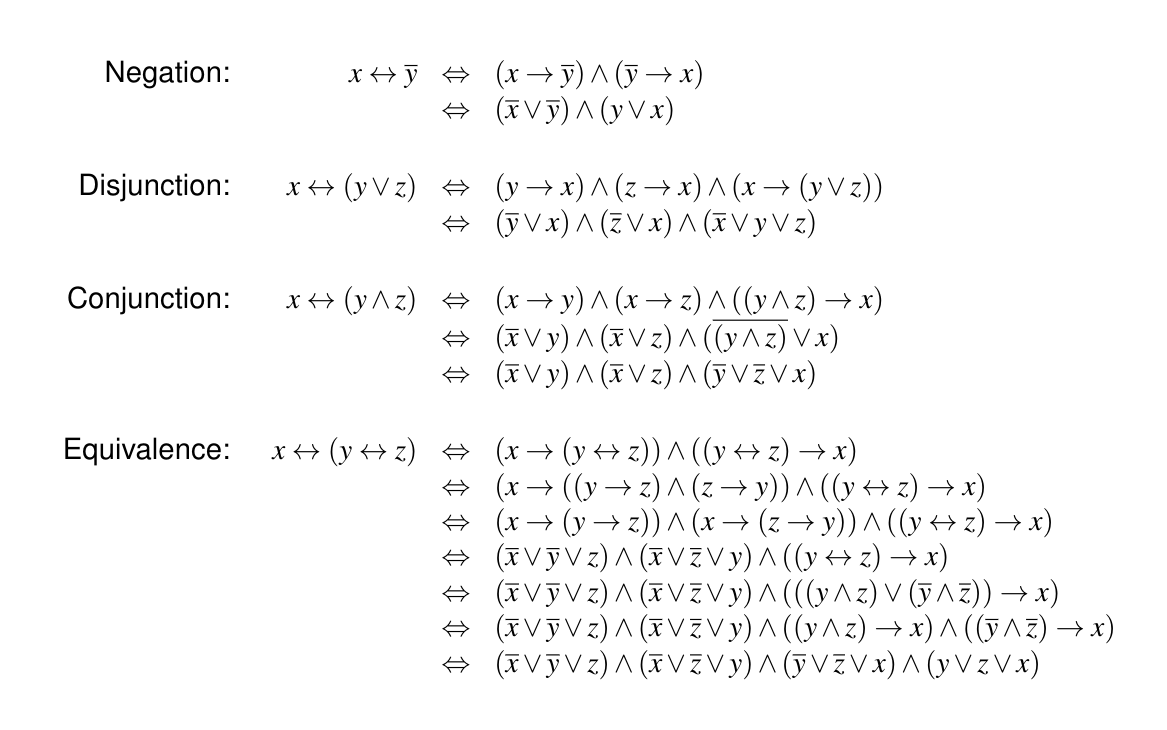
- The resulting formula grows linearly in respect to the size of the original formula
- Sometimes taking dividing into binary operations is not optimal (xor optimum is 3)

Plaisted–Greenbaum (PG)
- Only use implication instead of equivalence
\leftrightarrow - Direction depends on polarity of the subformula's occurrence
- Positive polarity: only need
x \rightarrow \varphi - Negative polarity: only need
\varphi \rightarrow x - Mixed polarity (e.g. under XOR/biconditional): need both, i.e. full Tseitin
x \leftrightarrow \varphi
- Positive polarity: only need
- Example
x \leftrightarrow (a \land b): positive occurrence needs(\overline x \lor a) \land (\overline x \lor b); negative occurrence needs just(\overline a \lor \overline b \lor x)- Positive occurrence:
xappears unnegated inF, e.g.F = x \lor c(asa\land bbecomes true,Fcan only become 'more satisfied')\Rightarrowonly needx \rightarrow (a \land b) - Negative occurrence:
xappears negated inF, e.g.F = \overline x \lor c(mirror case,Fbecomes 'more satisfied' asa \land bbecomes false)\Rightarrowonly need(a \land b) \rightarrow x
- Positive occurrence: