 nvrl
4eb663e2d7
The README grew a section per feature and is a good reference, but nothing
said where to begin. docs/wiki now has a getting-started page, a guide that
walks through one day with the workspace and explains each part where it comes
up, and a page per part of the app, each with screenshots of what it
describes.

Three pages are read out of the code rather than written, so they cannot drift
from it: the keys and commands from Help.svelte and commands.ts, the same lists
`:help` draws; the settings from .env.example, which gains a heading for the
vault, trash and history settings so they no longer sit under mail; and the
API from the README's table. `make wiki` writes them, and `--check` fails when
one is stale or a link between pages leads nowhere. `--publish` lays the pages
out for a GitHub wiki: links without `.md`, images beside them, `[[` escaped so
the wiki does not take a command's help text for a link to a page.

The screenshots are taken by `make screenshots`: the debug binary on a
temporary data directory, with a password made up for the run, filled with an
example workspace over the API, and a headless Chromium driven over the
DevTools protocol through the views the docs show. Nothing outside the
temporary directory is touched but docs/images, and the pictures are cut to
256 colours, a third of their size, which a dark UI does not show.

The README opens with the banner, a CI badge, the guide, the features grouped
by what they are for, and six of the screenshots.
7.2 KiB
The guide: a day with the workspace
This page follows one ordinary day: the agenda in the morning, notes and cards at work, a lecture in the afternoon, a thought on the way home, and the diary in the evening. Each part of the workspace is explained where it first comes up, with a link to the page that has the rest of it.
The keys are the desktop's. On a phone, every one of these has a button; see On a phone at the end.
Morning: what needs you
The first time you open the workspace each day, the agenda opens by itself
when anything is late or due. Any other time, press t.

It gathers the unfinished cards of every board into four groups:
- late: past their due date;
- today: due today;
- this week: due in the next seven days;
- in hand: in a list between the inbox and done, which means work has started on them.
Under the cards it says whether the diary has an entry for today, and lists what you wrote on this day in earlier years.
Walk it with j and k. On a card:
Spacefinishes it, where it stands;Dgives it a due date:fri,tm,+3d,10-31;HandLmove it to the list left or right on its board;Entergoes to the card on its own board.
Esc or t closes the agenda. The bar keeps showing the late and today
counts while either is above zero. More in Boards and the agenda.
At work: spaces, documents and tiles
Press 2 for the work space. A space is one area of your life, with its
own folders, its own board and its own search. Make more with
:space! <name>; w shows all of them at once, with what was last written in
each.

The list on the left shows the folder you are in. j and k move, l or
Enter opens what is under the cursor, h goes up a level. Folders come first,
then documents grouped by the day they were written.
Open the project notes with Enter. To read a second document beside it, move
to it and press L instead: it opens in a tile of its own.

Alt-h and Alt-l move between the tiles and back to the list, Alt-q
closes one, and f makes the focused one fill the screen. Each space remembers
its tiles, so switching away and back finds them as they were. More in
Spaces and documents.
Writing
i edits the open document. The editor is CodeMirror with real vim keys:
ciw, dd, visual mode, macros, . and the rest. Esc leaves insert mode,
and :q leaves the editor.

The document is markdown. Tables, code blocks, task lists and
math ($x^2$, or $$…$$ on its own) are drawn when you read it. Link to
another document by its title, [[Runbook]]; typing [[ offers the titles to
pick from. When the other document is renamed or moved, the link is rewritten
to follow it.
You do not need to save. Every keystroke goes to the browser's storage at once, and to the server a couple of seconds after you stop typing. If the network is gone, the draft waits in the browser and is sent when it comes back. More in Writing.
Cards
In a meeting someone asks you to renew a certificate. Press c, type
Renew the gateway certificate, and Enter. The card is in this space's
inbox, and you have not left the document you were reading.
Press b to see the board.

The first list is the inbox and the last is done; the ones between are work in
hand. h/l move between lists and j/k between cards. H/L move a
card across, Space finishes it, D sets its due date, and Enter opens its
notes: a document made for the card the first time you ask. :repeat weekly
makes a card come back in the inbox each time it is finished. q goes back to
the tree.
Finding things
/ searches the space you are in, as you type. Ctrl-P searches every space.
The search reads the documents and the text files in the tree: a log file is
found by a line inside it, and the result shows the words around the match.

Tab walks the results without leaving the line, Enter opens one, and
n/N step through them afterwards. More in Files and search.
Afternoon: a lecture
Press 3 for uni. The lecture notes have formulas in them, written as
LaTeX between dollar signs and drawn by KaTeX:

The slides came as a PDF. Drop it onto the list, or :upload, and it is a
file in the folder, beside the notes about it. Enter opens a PDF, an image, a
video, a CSV table, a text or source file, or a certificate in place. Anything
else downloads with :dl.

A scan of something private, like an ID or a contract, goes in with
:upload! instead. That seals it in the vault, under a password that is
never stored. See The vault.
On the way home: capture
A thought arrives when no tab is open. :token add phone makes a token. With
it, an iPhone Shortcut, an Android HTTP Shortcut or a single curl puts a card
in an inbox, or a line in today's diary entry:
curl -H "Authorization: Bearer nwc_…" -H 'content-type: application/json' \
  -d '{"text":"call the bank"}' https://your-host/api/capture
The token can do this and nothing else. See Capture.
Evening: the diary
Press T for today's entry. If there is none yet it is started, from the
diary's templates/day document when there is one, and opens ready to write.
C shows the diary by month. A dot marks a day with an entry; h/l,
j/k and H/L move by day, week and month, and Enter opens the day,
or starts an entry for it. In an entry, [d and ]d step to the one before
and after.

If nothing was written in the diary by the evening and mail is set up, a
reminder arrives at WORKSPACE_REMINDER_AT. More in The diary.
When something goes wrong
-
Deleted the wrong thing?
ubrings the last delete back.:trashlists everything deleted in the last 30 days. -
Overwrote a paragraph?
ghlists the document's earlier versions as diffs against the text as it is now, andEnterbrings one back.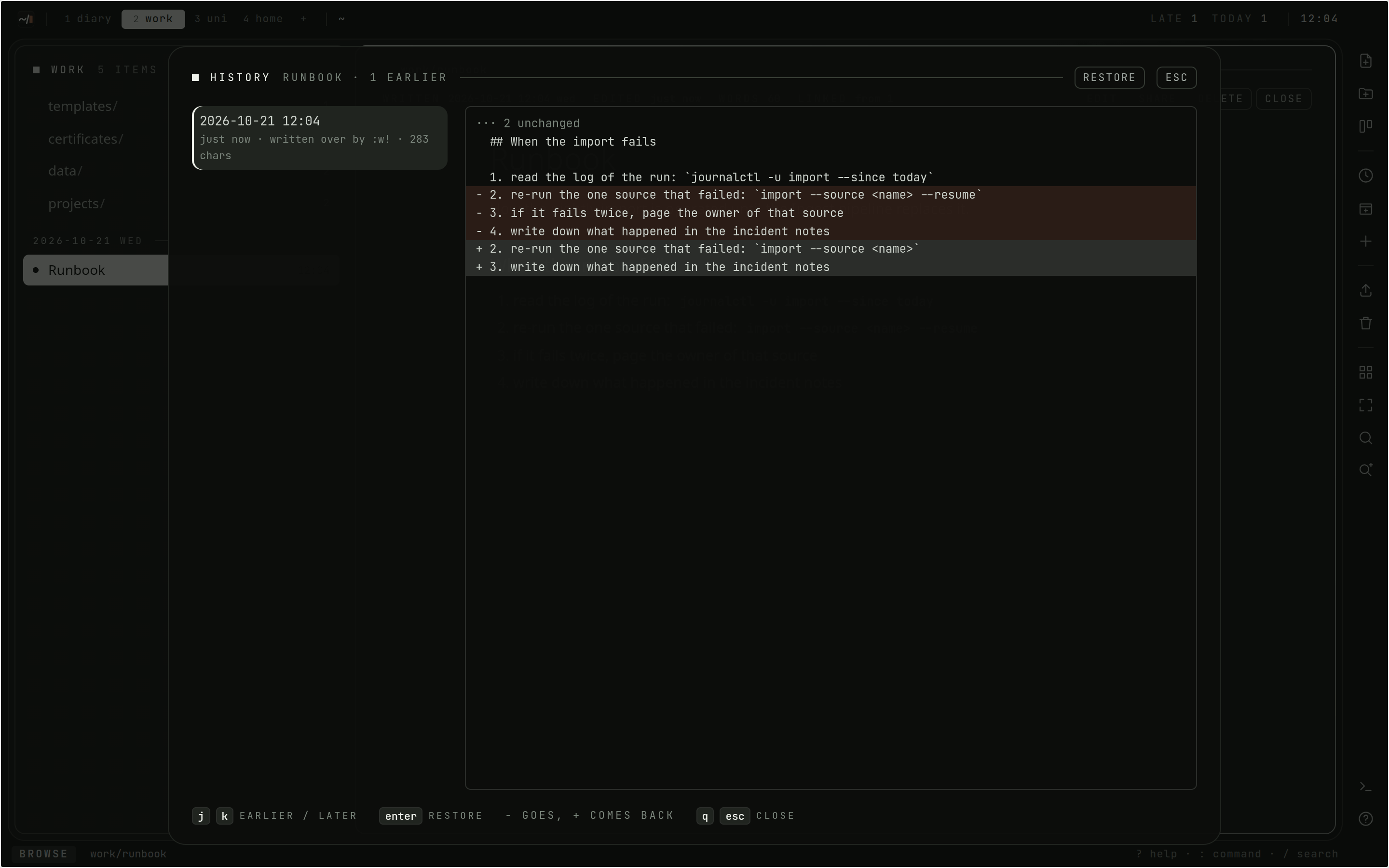
-
Saved in two places? A document saved somewhere else since you opened it is not overwritten:
:wsays so,:e!takes the other version, and:w!writes yours anyway.

More in Not losing things.
On a phone
On a touch screen the workspace drops the modal keys, and under 768 pixels
wide the list and the open document take the whole screen in turn. A dock along
the bottom has a new document, a new folder, the board, today's entry, an
upload, the trash and a search. The ⋯ on a row, or a long press, has
everything that can be done to it: rename, move, share, seal, delete. The agenda
has a done button on each card.
 |
 |
:set vim turns the vim keys on for a phone with a keyboard.