
3.5 KiB
3.5 KiB
Davis Putnam Procedure (DP)
while True:
	if [] in formula:
		return UNSAT
	//remove all variables that occur only in one phase
	vars = one_phased(formula)
	for var in vars:
		for clause in formula:
			if var in formula:
				remove(clause)

	var = decide(formula)

	// Add non trivial resolvants
	formula += resolution(var, formula)

	for clause in formula:
			if var in formula:
				remove(clause)

	if formula is []:
		return SAT
- Notice that
-
Adding a resolvant always preservers SAT (resolution rule)
-
Adding any clause always preserves UNSAT
-
Removing any clause always preserves SAT
-
Removing a clause containing a 'one phase variable' preserves UNSAT (reverse of resolution rule)
-
Davis Putnam Logemann Loveland DPLL
Boolean Constraint Propagation (BCP)
- Given a unit clause
l
- Remove all subsumed clauses, i.e.
Cwherel \in C - Remove
\lnot lfrom allC(which contain it) [Unit Prop](SAT_in_general#Special Case Unit Resolution)
def dpll(formula):
	if [] in formula:
		return UNSAT
		vars = one_phased(formula)
	for var in vars:
		for clause in formula:
			if var in formula:
				remove(clause)
	if formula is []:
		return SAT

	var = decide()
	if dpll(formula + [var]) == SAT:
		return SAT
	return dpll(formula + [-var])
- Correct because of theorem of Shanon
f(x) = (x \land f(1)) \lor (\overline x \land f(0))
Backjumping
- If some conflict has been derived without using specific assignments/ decision
- We can skip over that decision when flipping: !
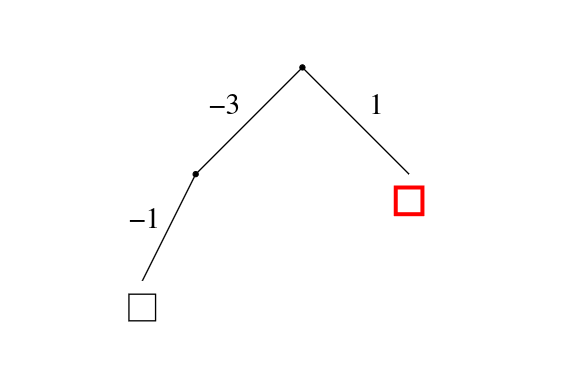
- If conflict stems from for example from (1 2) (1 -2)
- Removes 'bad decisions'/ 'useless' from the trail
- Can reduce search space from exponential to quadratic in number of bad decisions
- Whatever that means

CDCL
- DPLL with learning
- On conflict, learn a conflict clause which will help in further exploration
- Usually the first UIP of the [implication graph](SAT_in_general#Implication Graph) is used as conflict clause
- After learning a conflict:
- Back-jump to the lowest level in the implication graph supporting the UIP
- Assign negated UIP literal
- this is why first UIP is good (“pulls in” as few decision levels as possible)
Reduction
- Not all clauses are useful forever
- Useless via Subsumption, or trivially satisfied by units
- Try to reduce the amount of clauses you need to consider in BCP
- Schedule throwing away clauses
- geometric, Luby, arithmetic scheme
- Consider various heuristics
- Size
- Last Recently Used (LRU),
- Clause Move To Front (CMTF)
- Clause Scores similar to VSIDS
- Glucose/ Literal Block Distance (LBD)
- LBD = number of distinct decision levels among a (learned) clause's literals
- Low LBD ("glue clause"): literals tightly related across few levels -> likely useful, keep
- High LBD: literals span many levels, weakly related -> good deletion candidate
- Used flag
Restarts
- Schedule restarts every so often can improve performance
- Throw away the trail
- Keep (most) learned clauses, phase saving, other state
- Idea:
- The solver might have zoomed in on an efficient part of the search space
- For SAT instances might stuck in a UNSAT part
- For UNSAT instances might miss a shorter proof
- Avoid going down the same path by keeping what was learned
- Clauses, phase saving, variable scoring
- The solver might have zoomed in on an efficient part of the search space
Phase saving
- Whenever assigning a variable, save the phase it is assigned
- When deciding on a variable assign the saved phase
- Idea: Go down the right branch of the search tree